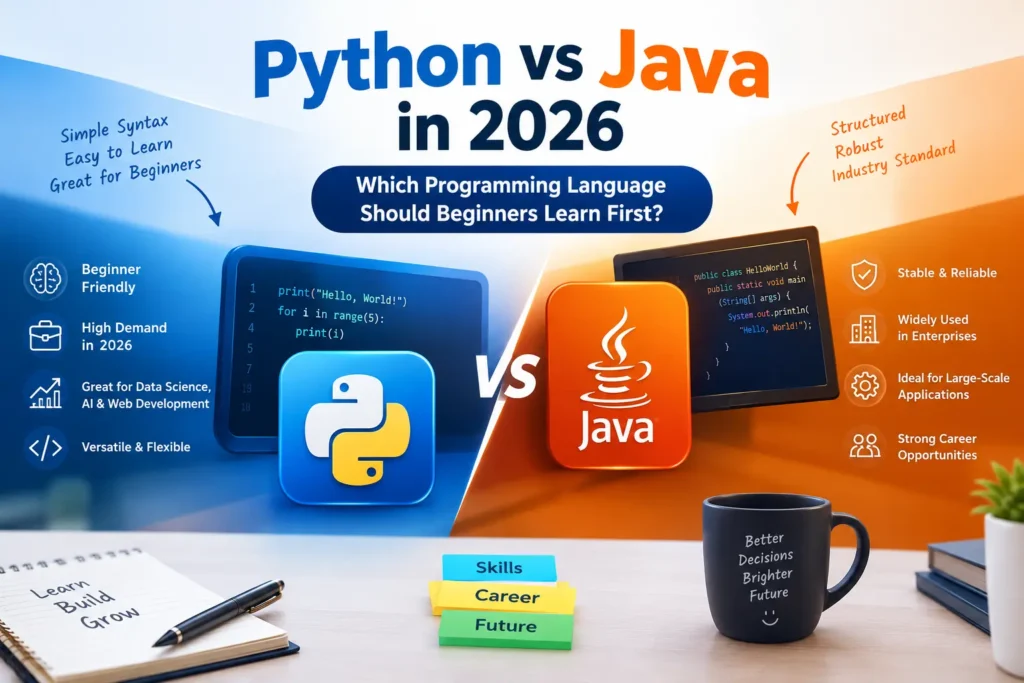
Python vs Java in 2026: Which Programming Language Should Beginners Learn First?
Choosing your first programming language can feel like a bigger decision than it really is. You may have heard that Python is easier, Java is better for software development, or one language offers more job opportunities than the other. The problem is that these statements leave out the most important question: What do you want to learn programming for?
At C-Cube Centre of Computer Education, Kolkata, we believe beginners should choose a language based on their current level, interests and intended direction—not simply because a language is popular. A good starting point is one you can practise consistently and use to build working programs.
In this guide, we compare Python vs Java in 2026 in simple terms, including learning difficulty, practical uses, career directions and a realistic first-month learning plan. By the end, you should be able to decide which programming language to learn first and what to do after learning the basics.
1. Python vs Java in 2026: The Short Answer
Python vs Java for beginners is not a contest with one universal winner. Both are established programming languages, but they suit different goals.
- Choose Python first if you are new to coding or interested in data analytics, data science, artificial intelligence, machine learning, automation, or Python-based web development.
- Choose Java first if you want to focus on structured software development, enterprise applications, backend systems, or Java-based development.
- If you are unsure, try a small program in each language. Then choose one to study consistently before moving on to the other.
Python usually feels easier at the beginning because its syntax is concise and readable. Java introduces more structure, including classes, data types, and a defined program entry point. That structure takes some getting used to, but it is useful when learning object-oriented programming and building larger applications.
The practical recommendation: do not spend months comparing languages. Choose the one that fits your likely direction, learn the fundamentals properly, and build small projects.
2. What Is the Difference Between Python and Java?
Python and Java are both general-purpose programming languages. You can use them to solve problems, process information and build software, but they approach some tasks differently.
What is Python?
The Python programming language is known for readable syntax and a broad range of applications. Beginners can write small programs without much setup code, which lets them focus on logic and problem-solving.
Python is widely used for:
- Data analytics and data science, including data cleaning, analysis, and visualization.
- Artificial intelligence and machine learning, using specialized libraries and frameworks.
- Automation and scripting, such as organizing files or processing repetitive tasks.
- Web development, using frameworks such as Django and FastAPI.
- Testing and technical workflows, where scripts can automate routine checks.
Python’s advantage is flexibility. However, learning Python syntax alone does not make someone a data analyst, AI engineer or software developer. Each path requires additional tools, concepts, and practical projects.
What is Java?
The Java programming language is known for its structured approach, static typing, and object-oriented programming model. It is widely used in enterprise software, backend services, and systems that need to be maintained over time.
Java is commonly used for:
- Enterprise application development, including business systems.
- Backend development, including applications built with Spring Boot.
- Banking and financial software, where Java is used in many established systems.
- Android development, alongside Kotlin and the current Android development ecosystem.
- Large software applications, where clear structure and maintainability matter.
Java asks beginners to understand more program structure early on. That can make the first few programs look longer, but it also introduces useful habits around types, classes, and organized code.
3. Python vs Java: Comparison Table
The following Python vs Java comparison focuses on factors that matter when choosing your first language.
| Factor | Python | Java |
|---|---|---|
| Beginner learning curve | Usually easier to start | Usually requires more initial setup |
| Syntax | Concise and readable | More explicit and structured |
| Type system | Dynamically typed | Statically typed |
| Enterprise backend | Used in many backend applications | Widely used, including with Spring Boot |
| Object-oriented programming | Supported | Central to typical Java learning |
| Data analytics and AI | Widely used | Possible, but Python is more common in many data and ML workflows |
| Automation | Strong choice for scripting and automation | Can automate tasks, though Python is often more convenient for short scripts |
| Program execution | Common implementations execute through an interpreter/runtime | Compiled to JVM bytecode and executed by the Java Virtual Machine |
| Best first choice | Beginners interested in data, AI, automation or a flexible starting point | Learners targeting Java-oriented software and backend development |
Which language is better? Python often wins on ease of starting; Java can be a more direct fit for learners who already want to focus on Java-based backend or enterprise development. Actual execution speed depends on the task, implementation, and libraries, so a simple “Java is always faster” claim would be misleading.
4. Which Language Is Easier for Beginners?
For most people who have never written code, Python is easier to learn than Java at the beginning. Its syntax is concise, so you can understand what a short program does without first learning as much surrounding structure.
For example, a Python program that prints a message is:
print("Hello, World!")A basic Java program needs a class and a main method:
public class Main {
    public static void main(String[] args) {
        System.out.println("Hello, World!");
    }
}
Both programs display the same message. The difference is how much structure you need to understand before getting the result.
Does that mean Java is too difficult for beginners?
No. Java for beginners is a reasonable choice if your goal is Java development and you are ready to practise its structure. The initial learning curve may be steeper, but the language provides a clear way to learn classes, objects, data types and organised program design.
What should you focus on first?
Whichever language you choose, learn these programming fundamentals:
- Variables and data types
- Operators and expressions
- Conditional statements
- Loops
- Functions or methods
- Lists or arrays and other data structures
- Debugging and problem-solving
- Basic object-oriented programming
Do not measure progress only by how many topics you have completed. Measure it by whether you can write a program, explain how it works, and correct it when it fails.
5. What Can You Build with Python?
If your interests include data, AI or automation, Python for beginners can be a practical starting point. You can begin with small programs and gradually move towards more specialised applications.
- A calculator or quiz program
- A script that organizes files
- A program that reads and summarizes a CSV file
- A simple data analysis project using a dataset
- A basic web application
- A beginner machine-learning experiment after learning the required foundations
If you want to move towards data analytics, Python is only one part of the learning path. You will also need to work with data, understand basic statistics, learn spreadsheet or database tools as appropriate, and practise explaining the results.
For a related learning path, read our Data Analytics Course in Kolkata page to understand how Python can fit into a broader data analytics learning journey.
6. What Can You Build with Java?
Java programming for beginners is a good route if you want to understand structured application development and are interested in backend or enterprise software.
Start with small programs such as:
- A student marks and grade calculator
- A bank account simulation
- A library book management program
- A basic inventory system
- A program that stores and retrieves information from a database
As your skills grow, you can explore object-oriented design, databases, testing, and frameworks such as Spring Boot for backend development.
Java is also relevant to Android development, although Kotlin is now an important part of modern Android development. If your main goal is to build Android applications, compare the current tools and learning requirements before choosing a path.
7. Python vs Java for Jobs and Career Goals in India
People often search Python vs Java job opportunities in India because they want to know which language can help them get a job. The more useful question is: which roles interest you, and what else will you need to learn for those roles?
Career directions that use Python
Python is relevant to roles and projects involving:
- Data analysis and data science
- Machine learning and AI
- Automation and scripting
- Backend development
- Software testing and test automation
These paths require different additional skills. For example, a data analyst may need spreadsheets, SQL, data visualisation and business communication. An AI or machine-learning role generally requires deeper knowledge of mathematics, statistics, data handling, and relevant frameworks.
Career directions that use Java
Java is relevant to roles and projects involving:
- Java application development
- Backend development with Java frameworks
- Enterprise software
- Database-driven applications
- Some Android development projects
For many Java backend roles, learning SQL, APIs, testing, version control and a framework such as Spring Boot is important alongside core Java.
Which language offers better salaries?
There is no dependable universal answer. Python vs Java salary comparisons depend on the role, location, employer, experience, technical depth and the skills required in the job description. Comparing a Python data analyst role with a senior Java backend role would not be a fair comparison.
Before choosing a language based on salary, review job listings for the type of role you want. Note the recurring skills, build projects that demonstrate those skills, and practise explaining your decisions during interviews.
Neither Python nor Java guarantees a job. Employers look for evidence that you can solve problems and apply your knowledge.
8. Should You Learn Python or Java First?
Use this decision guide to make a practical choice.
Choose Python first if:
- You are completely new to programming.
- You are interested in data analytics, AI or machine learning.
- You want to automate repetitive work.
- You want to build confidence through short, readable programs.
- You are still exploring several technical career directions.
If you want structured practice with Python fundamentals, explore our Python course in Kolkata to review the course content and see whether it matches your current level.
Choose Java first if:
- You already want to learn Java-based software development.
- You are interested in backend or enterprise applications.
- You want to study object-oriented programming through a strongly structured language.
- Your course, project or target role specifically requires Java.
If you want to focus on Java-based application development, explore our Java programming course in Kolkata to review the topics covered and the practical skills you will need to develop.
Can you learn both Python and Java?
Yes. But if you are a complete beginner, learning both at the same time can divide your attention. Start with one language, practise until you can independently build small programs, and then decide whether the second language supports your next goal.
The core ideas—conditions, loops, functions, data structures and problem-solving—transfer between languages. You will still need to learn each language’s syntax, tools and ecosystem.
9. A Practical Four-Week Beginner Learning Plan
This beginner programming roadmap gives you a way to move from comparing languages to actually writing code. Treat it as a starter plan, not a promise that everyone will master a language in four weeks. Your pace depends on your starting level and practice time.
Week 1: Learn the basics
Study variables, data types, operators, input and output, and conditional statements. Write small programs rather than only watching tutorials.
Practice goal: create a simple calculator and a program that checks whether a number is even or odd.
Week 2: Build your logic
Learn loops, functions or methods, and lists or arrays. Practise breaking a problem into smaller steps before writing code.
Practice goal: build a number-guessing game or a marks calculator.
Week 3: Work with structured data
Explore dictionaries or maps, strings, files and introductory object-oriented programming where appropriate. Learn how to read error messages and debug your work.
Practice goal: create a student record, contact list or simple expense tracker.
Week 4: Complete a small project
Choose a project that matches your interests. If you are learning Python, you might analyse a small dataset or automate a repetitive task. If you are learning Java, you might build a student record or library management program.
Practice goal: finish a working project, test it, document what it does and explain your code without relying entirely on copied solutions.
At the end of the month, review what you can do independently. Your next step should follow your goal: data analysis, backend development, software testing, automation or another area.
10. Frequently Asked Questions About Python vs Java
Is Python better than Java in 2026?
Neither language is universally better. Python is often a better starting point for beginners interested in data, AI, machine learning or automation. Java can be a better fit for learners targeting Java-based backend and enterprise development.
Which programming language should a beginner learn first?
Choose according to your goal. Python is usually easier to start with if you have no programming experience. Java is a sensible first choice if you already know that you want to focus on Java development.
Is Java harder than Python?
Java generally requires more program structure at the beginning, while Python uses more concise syntax. The difficulty you experience also depends on how you learn, how regularly you practise and the problems you attempt.
Can I learn Java after Python?
Yes. The programming concepts you learn in Java transfer to Python, although Python has its own syntax, conventions and libraries.
Which language is better for AI and data analytics?
Python is widely used for data analytics, data science and machine learning because of its libraries and ecosystem. For a data analytics career, combine Python with data handling, SQL, visualisation and the ability to interpret and communicate findings.
Is Java still worth learning?
Yes. Java remains relevant to enterprise software and backend development. Its usefulness for you depends on the types of applications and roles you want to pursue.
Does learning Python or Java guarantee a job?
No. Learning a language is one part of preparing for a technical role. You also need problem-solving ability, practical projects, relevant tools, communication skills and interview preparation.
11. Final Advice: Choose a Goal and Start Building
The real decision in Python vs Java for beginners is not about choosing the most popular language. It is about choosing a starting point that fits your goals and then practising enough to turn knowledge into ability.
If you want to explore data analytics, AI, machine learning or automation, Python is a sensible first choice. If you are aiming for Java-based backend or enterprise application development, Java is a sensible choice.
Do not try to learn every tool at once. Start with the fundamentals, build small projects, learn to debug your own code and keep a record of what you can explain and demonstrate.
If you are comparing programming learning options in Kolkata, explore the relevant course information and choose a path based on your current level, career interest and the practical skills you want to develop. The best next step is the one that gets you writing, testing and improving real programs consistently.
About the Author
Sudipta Chakraborty

Sudipta Chakraborty is the Centre Director and senior faculty mentor at C-Cube Centre of Computer Education, Kolkata, with more than 25 years of experience in computer education, student mentoring, and career-oriented skill development. He regularly writes about Data Analytics, emerging technologies, career trends, and practical learning approaches to help students and professionals make informed career decisions.
Readers interested in understanding more about the author’s professional background and experience in computer education can also connect through LinkedIn
Our Recent Blogs
- Python vs Java in 2026: Which Should Beginners Learn First?
- How to Learn Power BI from Scratch: A Beginner’s Roadmap to Data Analytics
- C-Cube Partners with Medhavi Foundation: A New Step Towards Skill-Based Certification
- How to Learn Advanced Excel in Kolkata: A Complete Roadmap for Beginners and Working Professionals
- Top Data Analytics Interview Questions for Freshers in 2026 (With Practical Answers)
- Data Analyst Roadmap 2026 – Step-by-Step Learning Guide for Beginners
- How Beginners Can Start Learning Data Analytics in Kolkata
- Why Students in Kolkata Are Choosing Data Analytics as a Career in 2026 ?
- Top 10 Computer Courses in Kolkata for Career Growth in 2026