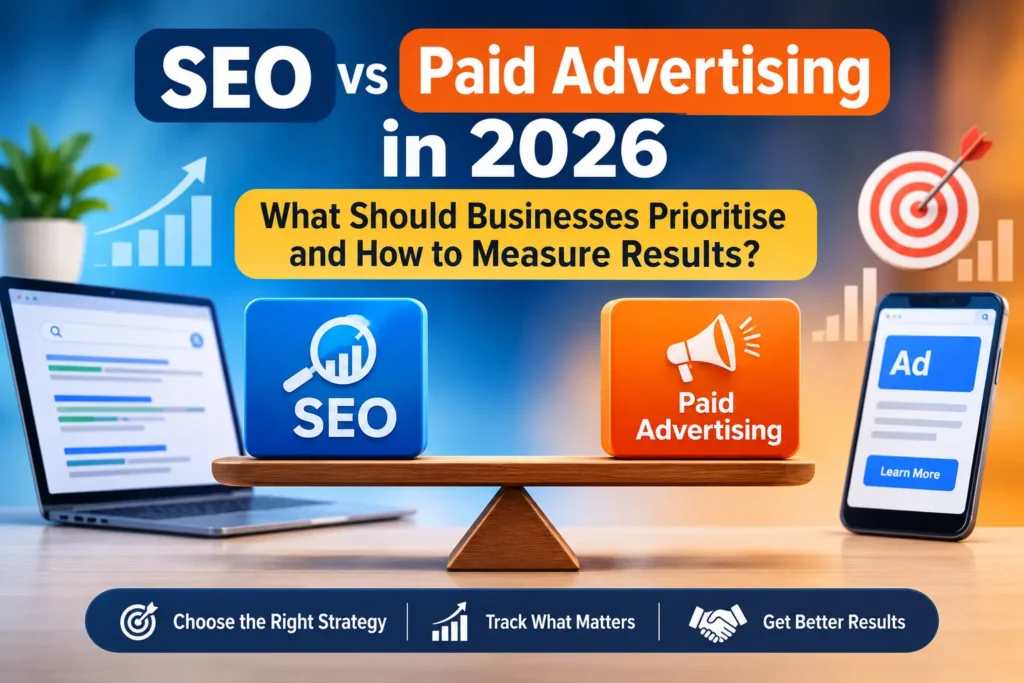
SEO vs Paid Advertising in 2026: What Should Businesses Prioritise and How to Measure Results?
A business can receive thousands of website visitors, generate hundreds of social media likes, and still struggle to get inquiries or sales. The problem is not necessarily a lack of online visibility. It may be that the marketing activity is attracting the wrong audience, targeting the wrong intent or failing to turn visitors into customers.
This raises two important questions: SEO vs paid advertising—which should a business prioritize? And how can marketers determine whether their digital marketing efforts are producing meaningful results?
The answer depends on the business objective, available budget, customer buying journey, and time frame. Search engine optimization (SEO) can help a website attract relevant organic traffic over time, while paid advertising can provide more immediate, controllable exposure. Neither channel guarantees leads or revenue on its own.
This guide explains how to choose between the two, when to use them together, and how to measure performance beyond website traffic and social media engagement.
What Is the Difference Between SEO and Paid Advertising?
SEO and paid advertising help businesses reach potential customers through different methods.
What Is SEO in Digital Marketing?
Search engine optimisation (SEO) is the process of improving a website so that search engines can understand its content and users can discover relevant pages through organic search results.
SEO activities can include:
- Researching search intent and relevant keywords
- Creating useful, original website content
- Improving page titles, headings, and internal links
- Making the website accessible to search engines
- Improving page experience and mobile usability
- Building relevant authority through genuine references and links
- Monitoring impressions, clicks, and search queries in Google Search Console
For example, a person searching for “how to learn Python as a beginner” is looking for educational information. A useful article answering that question may attract relevant organic visitors.
SEO is not a one-time task. Results depend on competition, content quality, website condition, demand, and many other factors. Rankings and traffic can change over time.
SEO and paid advertising are two important parts of modern digital marketing. Understanding how they work together can help businesses make better marketing decisions. If you want to learn these concepts through practical training, explore the Digital Marketing Course at C-Cube Centre of Computer Education, Kolkata.
What Is Paid Advertising?
Paid digital advertising involves paying a platform to display advertisements to a selected audience. Examples include Google Search Ads, Meta Ads on Facebook and Instagram, and other paid media campaigns.
Businesses can use paid campaigns to:
- Promote a new product or service
- Reach people searching for a particular solution
- Test different offers or landing pages
- Generate inquiries within a defined campaign period
- Reach selected locations or audience groups
- Measure clicks, leads, and campaign costs
For example, a local business may run Google Search Ads for a service when it wants to reach people actively looking for that service.
Paid advertising can produce traffic quickly, but traffic alone does not establish campaign success. The landing page, offer, targeting, competition, and follow-up process all influence the outcome.
SEO vs Paid Advertising: Key Differences
| Factor | SEO | Paid Advertising |
|---|---|---|
| Traffic source | Organic search results | Paid placements |
| Initial visibility | Often takes time to develop | Can begin after campaign approval and launch |
| Direct media cost | No payment per organic click, but work and tools may cost money. | An advertising budget is required. |
| Duration | Results may continue after active work but are not guaranteed. | Exposure generally depends on continued funding and campaign settings. |
| Main strengths | Relevant organic discovery and long-term visibility | Budget control, targeting, and campaign testing |
| Main limitations | Results are uncertain and may take time. | Costs can rise, and results may stop when campaigns stop. |
| Useful measurements | Search impressions, organic clicks, qualified leads, and conversions | Spend, clicks, cost per lead, conversions, and return |
The central difference is that SEO develops organic visibility, whereas paid advertising purchases exposure through an advertising platform. Google also explains that paid search advertising does not directly improve a website’s organic search rankings.
Should a Business Invest in SEO or Paid Advertising First?
There is no universal answer. The better starting point depends on what the business needs to achieve and how quickly it needs results.
When SEO Should Be a Priority
SEO deserves attention when a business wants to build a sustainable source of relevant organic discovery and can invest time in improving its website and content.
Consider prioritizing SEO when:
- Potential customers regularly search for your products or services.
- Your website has useful information but receives limited organic visibility.
- You can create content that answers specific customer questions.
- You want to improve visibility for relevant informational and commercial searches.
- You can monitor performance and improve pages over time.
For example, a business offering data analytics training could publish a detailed guide explaining the skills required to become a data analyst. A reader who finds that guide may later explore relevant training options.
This illustrates how SEO content marketing can connect an informational search with a relevant service. However, the article must genuinely answer the reader’s question; it should not simply exist to insert a sales message.
When Paid Advertising Makes More Sense
Paid advertising may be the more suitable initial channel when a business needs to test demand or promote an offer within a short time frame.
It can be useful when:
- A product launch or seasonal offer has a deadline.
- The business needs to test different messages or landing pages.
- There is an established conversion process.
- The target audience and offer are reasonably clear.
- The business can afford to test campaigns and measure results.
Before increasing the budget, establish what counts as a successful outcome. A campaign that generates many inexpensive clicks but no qualified inquiries may not be commercially effective.
Can SEO and Paid Advertising Work Together?
Yes. SEO and PPC marketing can support different parts of the same customer acquisition strategy.
A business might use paid search to test which queries and offers attract qualified enquiries while developing useful organic content for longer-term discovery. Search query and conversion data may help inform content priorities, although paid campaign results do not guarantee organic rankings.
For example:
- Use a limited advertising test to evaluate an offer.
- Identify the queries and landing pages that attract relevant prospects.
- Improve the website’s content and conversion process.
- Develop organic pages that address important customer questions.
- Continue measuring each channel separately and together.
The objective is not to choose a winning channel permanently. It is to allocate effort according to the evidence.
Why Website Traffic and Social Media Likes Can Be Misleading
Traffic, reach, impressions, and engagement are often called vanity metrics when they look impressive but do not explain whether marketing is achieving its objective.
These measurements are not useless. They become misleading when marketers treat them as proof of business success without examining what happened next.
Example 1—High Website Traffic but Few Enquiries
Imagine two hypothetical campaigns for the same service.
| Metric | Campaign A | Campaign B |
|---|---|---|
| Website visitors | 10,000 | 1,000 |
| Enquiries | 10 | 50 |
| Enquiry conversion rate | 0.1% | 5% |
Campaign A attracts ten times as many visitors, but Campaign B generates five times as many inquiries.
The lesson is not that lower traffic is always better. Campaign A may be attracting a broad audience, while Campaign B may be reaching people with stronger intent. The business should investigate audience relevance, landing-page content, traffic sources, and enquiry quality before deciding which campaign is more effective.
High Social Media Engagement but Little Business Impact
A social media post can receive hundreds of likes because it is entertaining, relatable, or widely shareable. That does not necessarily mean the audience is interested in the business’s products or services.
To assess its business impact, examine whether the post contributes to outcomes such as:
- Relevant website visits
- Product or service enquiries
- Qualified leads
- Sign-ups or purchases
- Meaningful conversations with potential customers
Social engagement can still be valuable for awareness and community building. It simply measures a different stage of the customer journey from a completed purchase or qualified lead.
Plenty of Ad Clicks but High Acquisition Costs
A paid campaign might generate a large number of clicks, but if the landing page is unclear or the offer does not match the advertisement, few visitors may convert.
In this situation, increasing the budget could increase spending without solving the underlying problem.
A better approach is to review ad relevance, landing-page conversion rate, lead quality, and cost per acquisition before scaling the campaign.
Which Digital Marketing Metrics Should Businesses Track?
The most useful metric depends on the objective of the campaign. A brand-awareness campaign and a lead-generation campaign should not be evaluated in exactly the same way.
Metrics for SEO Performance
For organic search, track:
- Search impressions: How often pages appear in search results.
- Organic clicks: How often users click through to the website.
- Click-through rate (CTR): The proportion of impressions that result in clicks.
- Search query relevance: Whether the queries match the page’s intended audience.
- Qualified organic leads: Enquiries from relevant visitors arriving through organic search.
- Conversions from organic traffic: Important actions completed by organic visitors.
Google Search Console can help analyse impressions, clicks, CTR and search queries. Website analytics can provide additional information about visitor behaviour and important actions.
A ranking improvement is useful context, but it should be evaluated alongside search intent, relevant traffic and the business outcome.
Metrics for Paid Advertising
For paid campaigns, useful measurements include:
- Advertising spend: The amount spent on the campaign.
- Cost per click (CPC): The average cost of an advertising click.
- Click-through rate (CTR): The proportion of impressions that result in clicks.
- Conversion rate: The proportion of the relevant visitors or clicks that complete the defined action.
- Cost per lead (CPL): Advertising spend divided by the number of leads generated.
- Customer acquisition cost (CAC): The relevant total acquisition cost divided by the number of new customers acquired, using a clearly defined cost scope.
- Return on ad spend (ROAS): Attributed revenue divided by advertising spend.
These metrics answer different questions. A low CPC does not necessarily mean a campaign is profitable, and a high ROAS does not automatically mean the business is profitable after product, delivery, staffing and other costs.
Metrics for Social Media and Content Marketing
For social media and content marketing, consider:
- Reach and impressions for awareness
- Engagement rate for audience interaction
- Relevant referral traffic to the website
- Newsletter or content sign-ups
- Assisted conversions where measurement supports them
- Qualified enquiries and sales attributable to the activity
The right digital marketing KPIs are those that help answer a specific business question. Avoid selecting metrics simply because they are easy to report.
How to Measure Whether a Digital Marketing Campaign Is Working
A practical measurement process begins before the campaign launches.
Step 1 —Define One Primary Objective
Choose a measurable objective, such as generating qualified enquiries, increasing relevant organic traffic or acquiring new customers.
“Get more visibility” may be a useful broad goal, but it needs a specific measurement plan.
Step 2 — Establish a Baseline
Record the current performance before making changes. Depending on the campaign, this could include organic clicks, website enquiries, conversion rate, advertising spend or customer acquisition cost.
Without a baseline, it is difficult to determine whether the results represent an improvement.
Step 3 — Configure Tracking
Use suitable analytics and platform reporting to track important actions, such as a completed enquiry form, a purchase or a qualified sign-up.
In Google Analytics 4, events that measure important actions are called key events. Advertising conversions are used to measure and optimise campaign performance in advertising platforms and reports. Set up tracking carefully and check that the events fire correctly before relying on the results.
Step 4 — Measure Lead Quality, Not Just Lead Volume
Not every enquiry becomes a customer. Where possible, distinguish between total enquiries, qualified leads, appointments, sales and repeat customers.
For a business receiving 40 enquiries, for example, knowing how many were relevant and how many became customers is more informative than knowing only the enquiry total.
Step 5 — Review Costs and Outcomes Together
Compare results with the original objective and the costs involved. For paid advertising, examine spend and acquisition outcomes. For SEO, consider the investment in content, technical work and ongoing optimisation alongside organic performance.
Do not assume that every sale can be credited to one channel. Customers may discover a business through search, return through social media and convert after a direct visit. Attribution reports provide useful evidence, but they do not always capture the full customer journey.
A Practical Digital Marketing Example for a Small Business
Consider a hypothetical local service business that wants to increase qualified enquiries while working with a limited budget.
Rather than immediately investing in every marketing channel, the business could take the following approach.
First, Improve the Website’s Conversion Process
Make sure the service, pricing information where appropriate, contact options and next steps are clear. A visitor should be able to understand the offer and enquire without unnecessary confusion.
Second, Address Relevant Organic Searches
Create or improve pages that answer real customer questions. Use clear headings, useful explanations and relevant internal links. Measure whether the pages attract the intended audience.
Third, Test Paid Advertising Carefully
Run a controlled campaign with a defined budget and objective. Use a relevant landing page and track qualified enquiries rather than treating clicks as the final result.
Fourth, Compare Results Using the Same Business Objective
Review the quality and cost of enquiries from each channel, while accounting for the different time frames and investment involved.
This is not a guarantee that one channel will outperform the other. It is a way to make decisions based on evidence rather than assumptions.
Common Digital Marketing Measurement Mistakes to Avoid
Even a well-planned campaign can be evaluated incorrectly. Watch for these common problems:
- Treating traffic as the final objective. Traffic matters when it reaches the right audience and supports a meaningful outcome.
- Comparing unlike campaigns. Different audiences, offers, budgets and time periods can make direct comparisons misleading.
- Ignoring lead quality. A large number of irrelevant enquiries can consume time without generating revenue.
- Increasing ad spend too early. Understand conversion performance and costs before scaling.
- Expecting immediate SEO results. Organic visibility often requires sustained work, and results are uncertain.
- Ignoring tracking errors. Missing or duplicated events can distort reported performance.
- Claiming every conversion for one channel. Attribution models may not capture every influence on a customer’s decision.
SEO vs Paid Advertising — Which Should You Prioritise in 2026?
The best approach depends on the problem the business needs to solve.
- If the objective is to develop organic visibility for relevant searches over time, prioritise SEO and useful website content.
- If the objective is to test an offer or reach a defined audience within a shorter period, consider paid advertising with controlled spending.
- If the business needs both immediate testing and longer-term organic discovery, use SEO and paid campaigns together, provided the budget and measurement process support it.
- If the business already receives traffic but few enquiries, investigate conversion rate, audience relevance and landing-page performance before investing more in traffic acquisition.
Most importantly, do not judge marketing solely by impressions, rankings, clicks or likes. These indicators are useful when interpreted in context, but the business should also understand what the activity contributes to its actual objectives.
Frequently Asked Questions
Is SEO better than paid advertising?
Neither is universally better. SEO can support long-term organic discovery, while paid advertising offers more immediate control over campaign exposure. The right choice depends on the business objective, competition, budget and time frame.
Should small businesses invest in SEO or Google Ads first?
A small business should assess its immediate needs, website readiness, customer search behaviour and available budget. If it needs to test demand quickly, a controlled advertising campaign may help. If it wants to build organic discovery over time, SEO deserves attention. Some businesses benefit from both.
Are website traffic and social media likes vanity metrics?
Not inherently. They are useful for understanding visibility and engagement. They become vanity metrics when reported without considering audience relevance, enquiries, conversions or the objective they are meant to support.
What is the most important KPI in digital marketing?
There is no single KPI for every campaign. A lead-generation campaign may prioritise qualified leads and cost per lead, while an e-commerce campaign may focus on purchases, revenue and acquisition cost. Choose metrics that reflect the objective.
How long does SEO take to produce results?
There is no fixed timeline. Results depend on the website, competition, content quality, technical condition and other factors. Monitor progress over an appropriate period rather than expecting a guaranteed ranking by a particular date.
How can I measure digital marketing ROI?
Define the relevant costs and attributable business outcomes first. For revenue-generating campaigns, compare the revenue or profit attributable to the activity with the relevant investment. Keep the cost scope consistent and recognise that attribution is not always exact.
Conclusion
Effective digital marketing is not simply about generating more visitors, clicks or social media engagement. It is about reaching the right audience, providing a relevant experience and measuring whether the activity supports the business objective.
SEO vs paid advertising should not be treated as a permanent competition between two channels. Each has a different role, and both can contribute when used with a clear strategy.
Start by defining the outcome you want, tracking the actions that matter and reviewing the evidence before increasing investment. When marketers move beyond surface-level metrics, they can make more informed decisions about where to focus their time and budget.
References for Further Reading
- Google Ads: SEO vs PPC: Understanding the Difference
- Google Search Central: SEO Starter Guide
- Google Analytics Help: Conversions vs. key events
About the Author
Sudipta Chakraborty

Sudipta Chakraborty is the Centre Director and senior faculty mentor at C-Cube Centre of Computer Education, Kolkata, with more than 25 years of experience in computer education, student mentoring, and career-oriented skill development. He regularly writes about Data Analytics, emerging technologies, career trends, and practical learning approaches to help students and professionals make informed career decisions.
Readers interested in understanding more about the author’s professional background and experience in computer education can also connect through LinkedIn
Our Recent Blogs
- SEO vs. Paid Advertising in 2026: What Should Businesses Prioritize and How to Measure Results?
- Python vs Java in 2026: Which Should Beginners Learn First?

- How to Learn Power BI from Scratch: A Beginner’s Roadmap to Data Analytics

- C-Cube Partners with Medhavi Foundation: A New Step Towards Skill-Based Certification

- How to Learn Advanced Excel in Kolkata: A Complete Roadmap for Beginners and Working Professionals
- Top Data Analytics Interview Questions for Freshers in 2026 (With Practical Answers)
- Data Analyst Roadmap 2026 – Step-by-Step Learning Guide for Beginners

- How Beginners Can Start Learning Data Analytics in Kolkata

- Why Students in Kolkata Are Choosing Data Analytics as a Career in 2026 ?

- Top 10 Computer Courses in Kolkata for Career Growth in 2026

- 25 Years of C-Cube Centre of Computer Education – Building Skills, Careers, and Trust in Kolkata

- What Students Should Look for in an IT Training Institute in Kolkata ?