Data Analyst Roadmap 2026: Step-by-Step Guide for Beginners
For over 25 years, while guiding students, graduates, and working professionals, we have observed that many learners are interested in building a Data Analyst career, but often feel confused about where to begin. Questions such as “Should I learn Excel first?”, “Do I need Python?”, and “How long does it take to become job-ready?” are extremely common.
The good news is that becoming a Data Analyst does not require learning everything at once. A structured Data Analyst Roadmap 2026 helps learners gradually build practical skills, analytical thinking, project experience, and industry readiness.
This guide shares a step-by-step Data Analytics learning path designed specifically for beginners who want to develop practical skills and prepare for future career opportunities.
Why Data Analytics Continues to Be a Valuable Career Skill in 2026?
Over the years, while working with students and professionals pursuing technology careers, we have observed that industries increasingly value individuals who can understand, interpret, and work confidently with data. Today, organizations no longer rely solely on assumptions; they depend on data-driven decision making for reporting, planning, customer analysis, forecasting, and business growth.
What makes Data Analytics particularly valuable in 2026 is its applicability across multiple industries. Whether it is finance, healthcare, retail, marketing, logistics, or technology, employers are actively seeking professionals who can transform data into meaningful business insights.
From our experience, learners who develop practical Data Analytics skills, analytical thinking, and reporting abilities often find themselves better prepared for evolving workplace requirements and long-term career growth.
Can a Beginner Become a Data Analyst in 2026?
One of the most common questions we receive from students is whether a beginner without an IT background can build a successful Data Analytics career.
Our answer is usually yes.
Over the years, we have seen learners from commerce, arts, science, management, and even completely non-technical backgrounds successfully develop Data Analyst skills through structured learning and consistent practice. In most cases, success depends less on previous academic background and more on willingness to learn analytical thinking, reporting techniques, and practical problem-solving.
This learning path can be suitable for:
- Graduates
- Commerce Students
- Working Professionals
- Career Changers
- Non-Technical Learners
While self-learning can provide a starting point, a structured Data Analytics Training Program often helps learners build skills more systematically through guided practice, real datasets, and project-based learning.
What Does a Data Analyst Actually Do?
Many beginners assume that a Data Analyst spends most of the day writing code. In reality, what we observe across industries is that analysts primarily help organizations make better business decisions using data.
A Data Analyst typically works with information collected from various sources, organizes it, identifies trends, creates reports, develops dashboards, and communicates findings to decision-makers.
Common responsibilities often include:
- Data Collection
- Data Cleaning
- Report Creation
- Dashboard Development
- Trend Analysis
- Business Reporting
- Performance Monitoring
From our experience, analytical thinking and business understanding are often just as important as technical tool knowledge.
What Should You Learn First: Excel, SQL, Python or Power BI?
One mistake we frequently observe among beginners is trying to learn multiple tools simultaneously. While the enthusiasm is understandable, it often creates confusion and slows overall progress.
For most learners, a structured Data Analytics learning path works far better.
Based on our experience guiding students, we usually recommend:
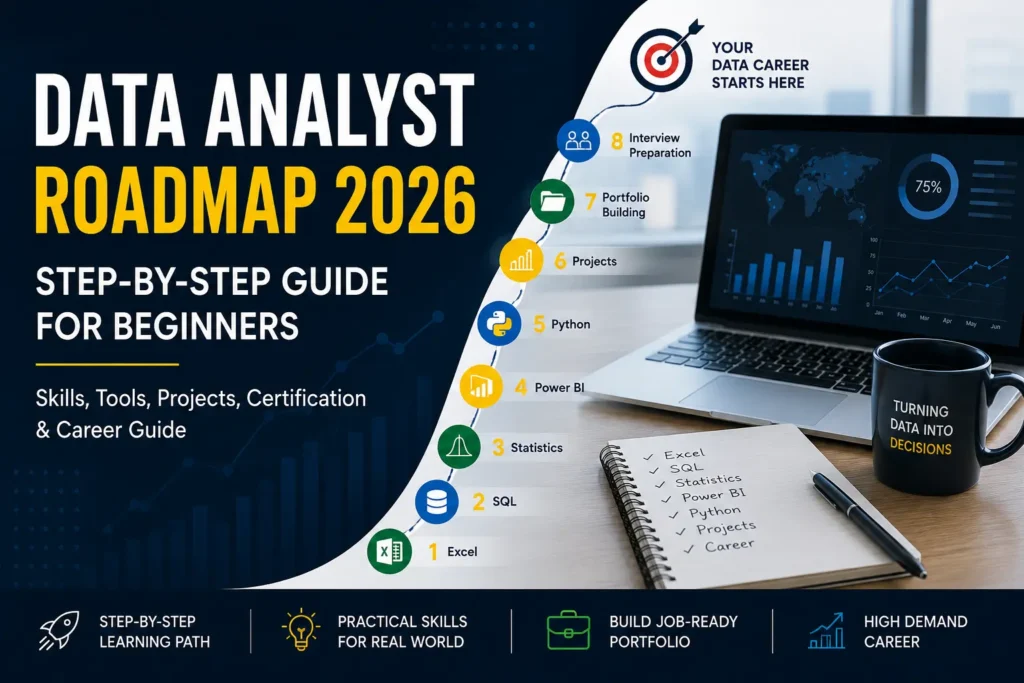
Excel → SQL → Statistics → Power BI → Python
This sequence helps learners gradually develop reporting ability, data understanding, visualization skills, and analytical thinking before moving toward automation and advanced analysis.
Rather than focusing on tools alone, learners should focus on understanding how data is used to solve real business problems.
One factor that often influences learning outcomes is the quality of the learning environment itself. Students evaluating different learning options can also explore our guide on choosing the right Data Analytics Training Institute in Kolkata for practical skill development.
Quick Data Analyst Roadmap 2026 Overview
| Step | Focus Area |
|---|---|
| Step 1 | Advanced Excel |
| Step 2 | SQL |
| Step 3 | Statistics Fundamentals |
| Step 4 | Power BI |
| Step 5 | Python |
| Step 6 | Practical Projects |
| Step 7 | Portfolio Building |
| Step 8 | Interview Preparation |
Stage 1: Learn Advanced Excel for Data Analysis
Even today, Advanced Excel remains one of the most widely used tools in business reporting and analytics. We have observed that many organizations still rely heavily on Excel for reporting, MIS preparation, dashboard creation, and operational analysis.
Every successful Data Analyst begins by understanding data organisation, reporting, and spreadsheet analysis. Our Advanced Excel Training in Kolkata helps learners build these practical skills before progressing to SQL, Power BI, and Python. build strong Excel skills often find it easier to understand later tools such as SQL, Power BI, and Python.
Important topics include:
- Functions & Formulas
- Pivot Tables
- Data Cleaning
- Dashboards
- Charts & Visualizations
- Business Reporting
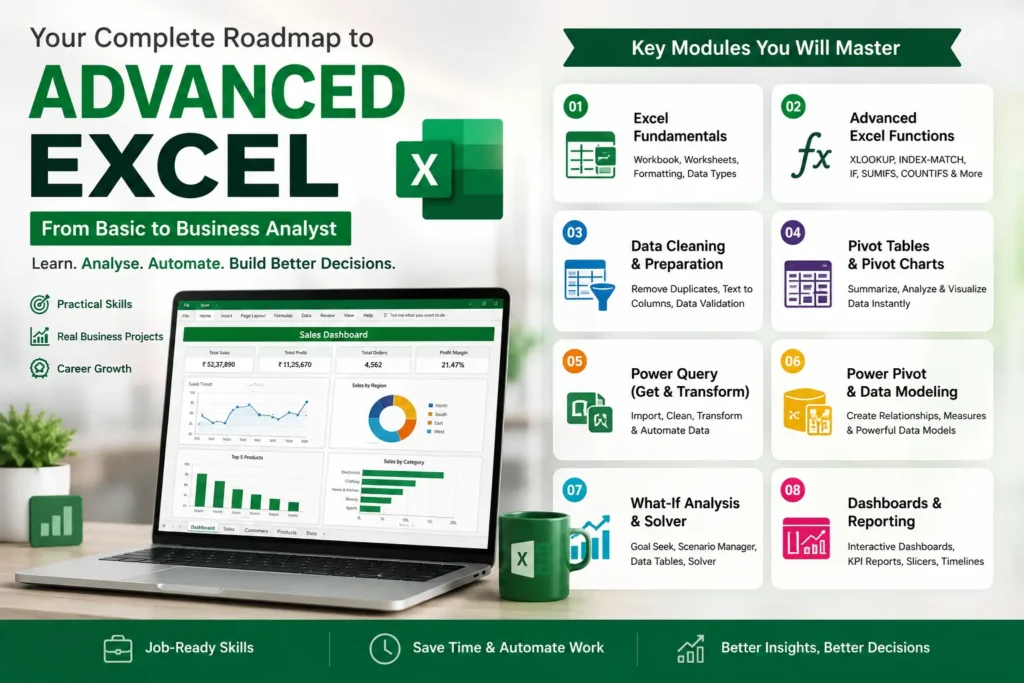
One of the first technical skills every aspiring Data Analyst should master is Microsoft Excel. Our detailed Advanced Excel Learning Roadmap explains how beginners can gradually build reporting, dashboard, and data analysis skills before moving to SQL and Python.
Stage 2: Learn SQL for Data Analysis
Once learners become comfortable working with data in Excel, the next logical step is SQL.
In our experience, SQL helps students understand how data is stored, retrieved, filtered, and analyzed in real business environments. Since many organizations maintain large databases, SQL continues to be one of the most important skills for aspiring analysts.
Important concepts:
- SELECT Queries
- Filtering Data
- Sorting Records
- GROUP BY
- JOIN Operations
- Business Queries
Stage 3: Understand Statistics Fundamentals
Many beginners feel intimidated by statistics, but in reality, basic statistical understanding helps analysts interpret data more accurately.
From our experience, students do not need advanced mathematics to start learning analytics. However, understanding statistical concepts often improves decision-making and analytical confidence.
Important topics include:
- Mean
- Median
- Mode
- Percentage Analysis
- Standard Deviation
- Probability Basics
Stage 4: Learn Power BI for Dashboards and Visualization
Power BI has become one of the most widely adopted Data Visualization tools in modern organizations.
We have observed that employers increasingly expect analysts to communicate findings through dashboards and visual reports rather than large spreadsheets.
Key Skills include:
- Dashboard Design
- KPI Reporting
- Interactive Visualizations
- Business Reporting
- Data Storytelling
Stage 5: Learn Python for Data Analytics
Python is often introduced later in the learning journey because students benefit more when they first understand reporting and analytical concepts.
From our experience, learners who already understand Excel, SQL, and visualization tools usually find Python easier to apply in real-world scenarios.
Important areas include:
- Pandas
- Data Cleaning
- Data Manipulation
- Data Visualization
- Analytical Workflows
Stage 6: Build Practical Projects
One observation we consistently make is that projects often create the biggest difference between theoretical knowledge and practical confidence.
Employers frequently evaluate a learner’s ability to apply concepts rather than simply complete a course.
Useful project ideas include:
- Sales Performance Dashboard
- Customer Behavior Analysis
- Marketing Campaign Analysis
- Financial Reporting Dashboard
- Retail Analytics Project
From our experience, project work is often where learners begin connecting theoretical concepts with real business scenarios. Readers interested in understanding how hands-on learning supports long-term skill development can explore our guide on Practical Data Analytics Training.
Stage 7: Build a Professional Portfolio
Many learners complete training programs but forget to showcase their work effectively.
A strong portfolio often becomes evidence of practical skills and problem-solving ability.
Include:
- Excel Dashboards
- SQL Projects
- Power BI Reports
- Python Analysis Projects
- Data Visualization Projects
From our experience, a well-structured portfolio often creates a stronger impression than certificates alone.
Stage 8: Prepare for Interviews
Interview preparation should begin alongside project development rather than after completing all tools.
Employers often focus on how candidates approach problems, explain projects, and interpret business scenarios.
- Project Discussion
- Problem Solving
- Tool Knowledge
- Reporting Skills
- Business Understanding
- Dashboard Explanations
How Long Does It Take to Become Job-Ready?
One of the most common questions students ask is how quickly they can become job-ready.
From our experience, there is no fixed timeline because learning speed varies significantly from person to person. However, learners who follow a structured roadmap, practice consistently, and work on projects often develop practical confidence within 6 to 8 months.
Instead of focusing on completing tools quickly, we generally advise students to focus on building practical skills, business understanding, and project experience.
Data Analyst Roadmap 2026 for Students in India
For students in India, we have observed that employers increasingly value practical capability over theoretical knowledge alone.
While certifications can be useful, hiring managers often look for evidence that candidates can work with data, create reports, build dashboards, and solve business problems.
A balanced combination of:
- Excel
- SQL
- Statistics
- Power BI
- Python
- Projects
often creates a strong foundation for entry-level analytics roles.
Common Mistakes Beginners Should Avoid
Over the years, we have observed several mistakes that repeatedly slow down learner progress.
Some of the most common include:
- Learning too many tools simultaneously
- Skipping practical projects
- Ignoring Excel fundamentals
- Focusing only on certifications
- Avoiding portfolio creation
- Delaying interview preparation
In most cases, learners who follow a structured roadmap and practice consistently tend to achieve better long-term results.
Career Opportunities After Learning Data Analytics
One of the reasons many students are exploring Data Analytics careers is the diversity of opportunities available across industries.
Depending on skills, project experience, and business understanding, learners may explore roles such as:
- Data Analyst
- Reporting Analyst
- Business Analyst
- MIS Executive
- Analytics Associate
- Dashboard Developer
From our experience, long-term career growth depends less on learning a specific tool and more on developing analytical thinking, reporting ability, communication skills, and confidence in solving real-world business problems. These qualities often continue to create opportunities even as tools and technologies evolve.
Career paths in analytics continue to expand across multiple industries. Readers interested in exploring emerging roles, industry demand, and long-term growth prospects can learn more about Career Opportunities in Data Analytics.
Salary, Career Growth & Certifications for Data Analysts in 2026
One of the questions almost every aspiring data analyst asks at some point is:
“Is data analytics really a good career choice in 2026 and beyond?”
After guiding students, fresh graduates, and working professionals through their learning journeys, we have noticed that the answer depends less on the market and more on how you approach your skill development.
Data analytics is not just a job role; it is often the starting point of a much larger career journey. Many professionals begin as junior data analysts and eventually move into senior analytics positions, business intelligence roles, data science, machine learning, or even leadership positions managing analytics teams.
We have noticed that professionals who learn only basic spreadsheet skills often find themselves competing for entry-level opportunities. On the other hand, candidates who develop practical expertise in SQL, Power BI, Python, dashboard development, and data storytelling generally position themselves for stronger opportunities and faster salary growth.
Explore more career-focused technology learning resources through C-Cube Centre of Computer Education.
Typical Salary Progression for Data Analysts in India
| Experience Level | Typical Role | Expected Salary Range |
|---|---|---|
| 0–1 Year | Junior Data Analyst | ₹3 LPA – ₹6 LPA |
| 1–3 Years | Data Analyst | ₹5 LPA – ₹10 LPA |
| 3–5 Years | Senior Data Analyst | ₹8 LPA – ₹15 LPA |
| 5–8 Years | Analytics Lead | ₹15 LPA – ₹25 LPA+ |
| 8+ Years | Analytics Manager / Head of Analytics | ₹25 LPA – ₹50 LPA+ |
Do You Need Certifications to Become a Data Analyst?
Certifications can certainly strengthen your resume, especially if you are a fresher or transitioning into data analytics from another field. However, from what we have observed, employers are usually more interested in seeing how you apply your knowledge through projects, dashboards, and real-world problem-solving than simply the number of certificates you hold.
Data Analyst Career Growth Path
One of the biggest advantages of starting as a data analyst is that it opens multiple career paths. As your analytical and technical skills improve, you can move into specialized or leadership roles.
A typical career progression looks like this:
Junior Data Analyst → Data Analyst → Senior Data Analyst → Analytics Lead → Analytics Manager → Head of Analytics
However, many professionals also transition into related fields, such as:
- Business Analytics
- Product Analytics
- Marketing Analytics
- Financial Analytics
- Data Engineering
- Machine Learning Engineering
- Data Science
- Artificial Intelligence
Final Thoughts
A successful Data Analyst journey rarely depends on learning a single tool. Instead, it is usually built through consistent practice, structured learning, practical projects, and continuous skill development.
Students who follow a step-by-step roadmap often find it easier to develop analytical thinking, build confidence, and prepare for future opportunities in the growing field of Data Analytics.
For learners planning to follow this roadmap through a structured curriculum that combines Excel, SQL, Statistics, Power BI, Python, projects, certification, and career guidance, our Data Analytics Courses in Kolkata provides a practical learning pathway designed for beginners and working professionals.
Frequently Asked Questions
Is Data Analytics a good career in 2026?
Yes. Organizations across industries increasingly rely on data-driven decision-making.
Can a non-IT student become a Data Analyst?
Yes. Many professionals enter analytics from commerce, management, and non-technical backgrounds.
Do I need Python to become a Data Analyst?
Python is valuable but usually comes after Excel, SQL, Statistics, and Power BI.
How many projects should I build?
At least 3–5 practical projects are recommended.
Is certification necessary?
Certification can support learning, but practical skills and projects often carry greater weight.
About The Author
Sudipta Chakraborty

Sudipta Chakraborty is the Centre Director and senior faculty mentor at C-Cube Centre of Computer Education, Kolkata, with more than 25 years of experience in computer education, student mentoring, and career-oriented skill development. He regularly writes about Data Analytics, emerging technologies, career trends, and practical learning approaches to help students and professionals make informed career decisions.
Connect with Sudipta Chakraborty on LinkedIn for insights on technology education, career guidance, and practical skill development.
Our Recent Posts
- C-Cube Partners with Medhavi Foundation: A New Step Towards Skill-Based Certification

- How to Learn Advanced Excel in Kolkata: A Complete Roadmap for Beginners and Working Professionals
- Top Data Analytics Interview Questions for Freshers in 2026 (With Practical Answers)
- Data Analyst Roadmap 2026 – Step-by-Step Learning Guide for Beginners
- How Beginners Can Start Learning Data Analytics in Kolkata